MediaConsole: Turning spreadsheet chaos into scalable SEO operations
Founding Product Designer
Product discovery
May 2023 — Nov 2025
B2B SaaS
Web
TL;DR
Challenge: Validate whether spreadsheet-based SEO operations could become a scalable B2B SaaS product.
Role: As Founding Product Designer at an early-stage startup, I led product discovery, strategy, and design in a Lean Startup environment, combining the responsibilities of UX Researcher, Product Designer, and Product Manager.
Outcome: Validated the product direction through customer research and rapid experimentation, helping launch the first version of the platform for enterprise customers.
Download the full case study deck documenting key decisions, design iterations, and validation.
Business context
MotherLink, an Estonian SEO marketplace, discovered that its largest customers had outgrown traditional SEO tools. As agencies scaled, spreadsheets became operational bottlenecks, making collaboration, reporting, and campaign management increasingly difficult.
Before investing in a new product, leadership partnered with them to validate whether these challenges represented a scalable business opportunity.
Validating the opportunity
Before designing a product, we needed to answer a more fundamental question:
Could spreadsheet-based SEO operations become a scalable B2B SaaS product?
Rather than starting with features, I focused on understanding how agencies actually managed SEO campaigns. I conducted 15 interviews with customers, SEO specialists, internal stakeholders, and industry experts to uncover how work flowed from one stage to the next, and where existing tools broke down.
Spreadsheets worked until teams scaled
One of the most interesting discoveries was that every agency described its workflow as unique. However, when I mapped their day-to-day activities, a different pattern emerged.

Despite differences in terminology and internal processes, agencies followed the same sequence of work: planning a campaign, searching for websites, purchasing backlinks, collaborating with publishers, processing payments, tracking performance, and renewing backlinks. Yet almost all of them tracked their activities in spreadsheets or CRMs that haven’t been optimized for SEO marketing. As agencies grew, spreadsheets became increasingly difficult to maintain, resulting in duplicated work, limited visibility, and growing operational overhead.
This insight shifted the design challenge from replicating spreadsheets to building a product around the shared operational patterns behind them.
So, how might we replace custom workflows with a configurable platform that works for every SEO team?
From insights to product
Turning product assumptions into solutions
Every major capability started with the customer problem and expected outcomes, supported by FAQ-style documentation that aligned stakeholders before development.
Phase #1: Build fast. Learn faster
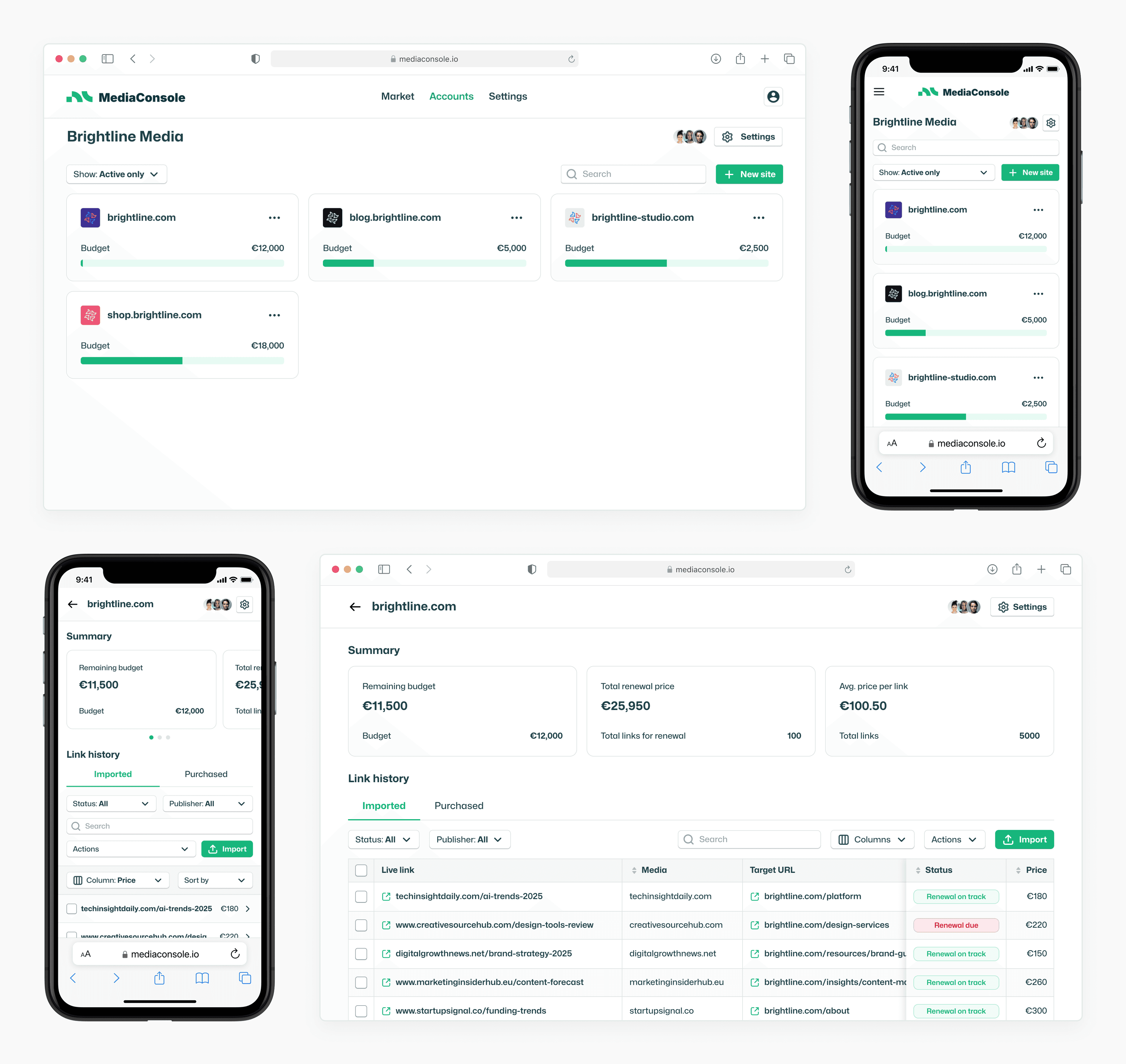
Rather than investing in a fully configurable platform from day one, we launched an MVP using existing MotherLink components to observe real customer behavior and validate the product's core workflow.
The first challenge was creating a stable foundation that customers could adopt without disrupting their existing processes. To accelerate development, I reused and adapted components from the existing MotherLink marketplace design system, reducing engineering effort and enabling rapid iteration.
The MVP established the core building blocks of the product, including:
Media database import
Historical backlinks import
Workspace setup
Publisher and website entities
Mobile-friendly interactions for quick status checks
By reusing components, we focused efforts on validating the product concept rather than rebuilding familiar interface patterns. The goal of this phase was to build confidence in the product's workflow structure and learn from real customer behavior before investing in a configurable workflow.
Phase #2: One workflow. One Order
Once the MVP validated the product's foundation, the next challenge was standardizing how teams managed SEO work without forcing them into rigid processes.
To explore this, I facilitated a workflow-mapping workshop with the customer’s team. Together, we mapped every step of their workflow, from identifying websites to completing placements and managing renewals. Despite initial assumptions that every agency worked differently, the workshop reinforced what the earlier research had already suggested: the underlying workflow was remarkably consistent.

Hypothesis: What if every placement request became an Order moving through a configurable workflow?
This hypothesis shifted the product from a collection of tools to a workflow-driven platform. Instead of managing websites, publishers, and tasks independently, teams could coordinate their work around a single core entity — the Order.
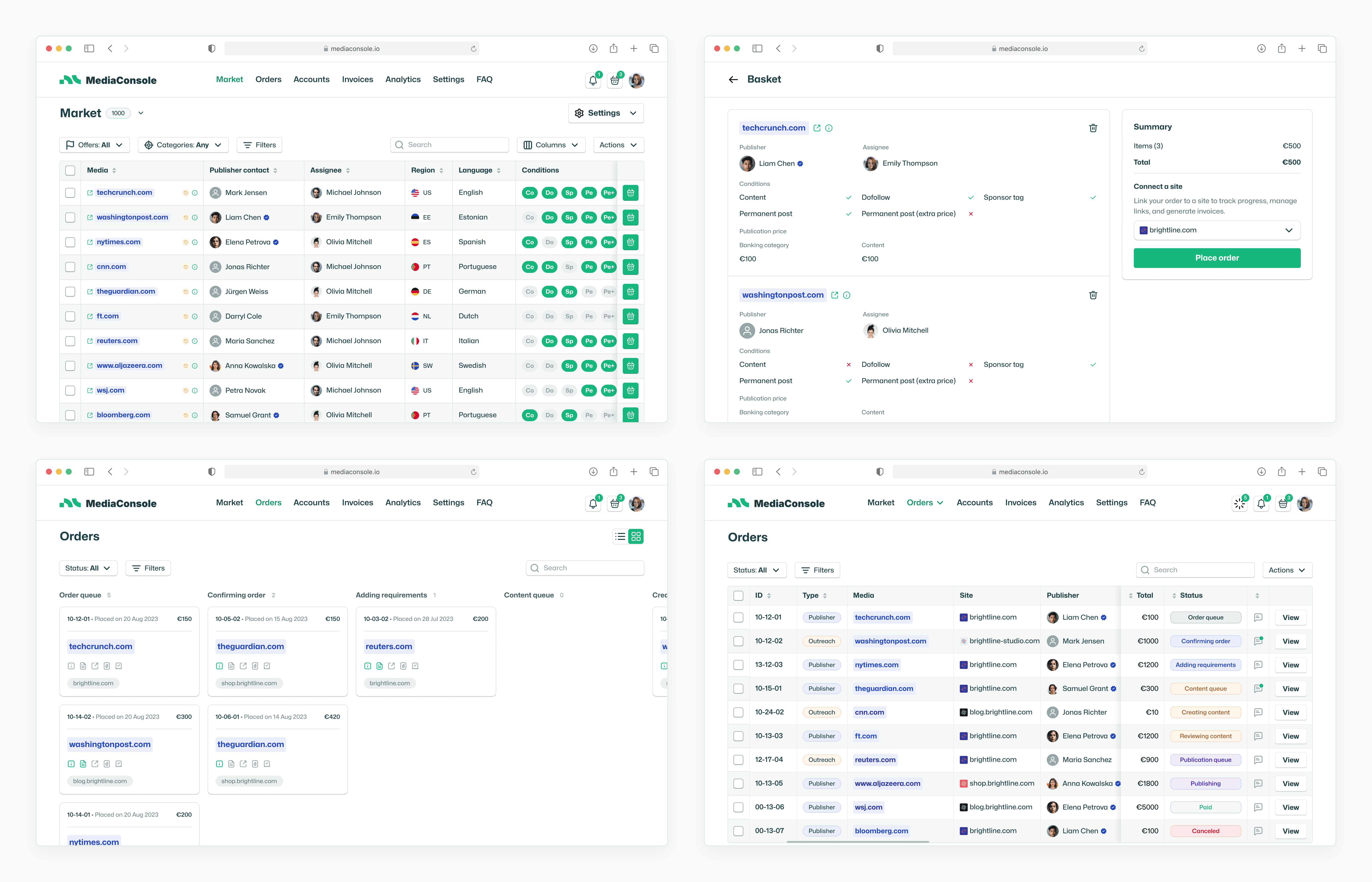
We launched the first version of the Order workflow, allowing teams to convert website purchases into Orders and manage them through a shared workflow. Kanban and List views supported different ways of working while preserving the same underlying workflow.
Eventually, we abandoned the Kanban view as teams hesitated to use it and preferred the List view.
Learning: Customer behavior validated the Order workflow as the foundation for scaling the product.

Phase #3: Scaling SEO operations
Once the Order workflow proved successful, the next challenge was supporting the entire SEO operation rather than individual placement requests.
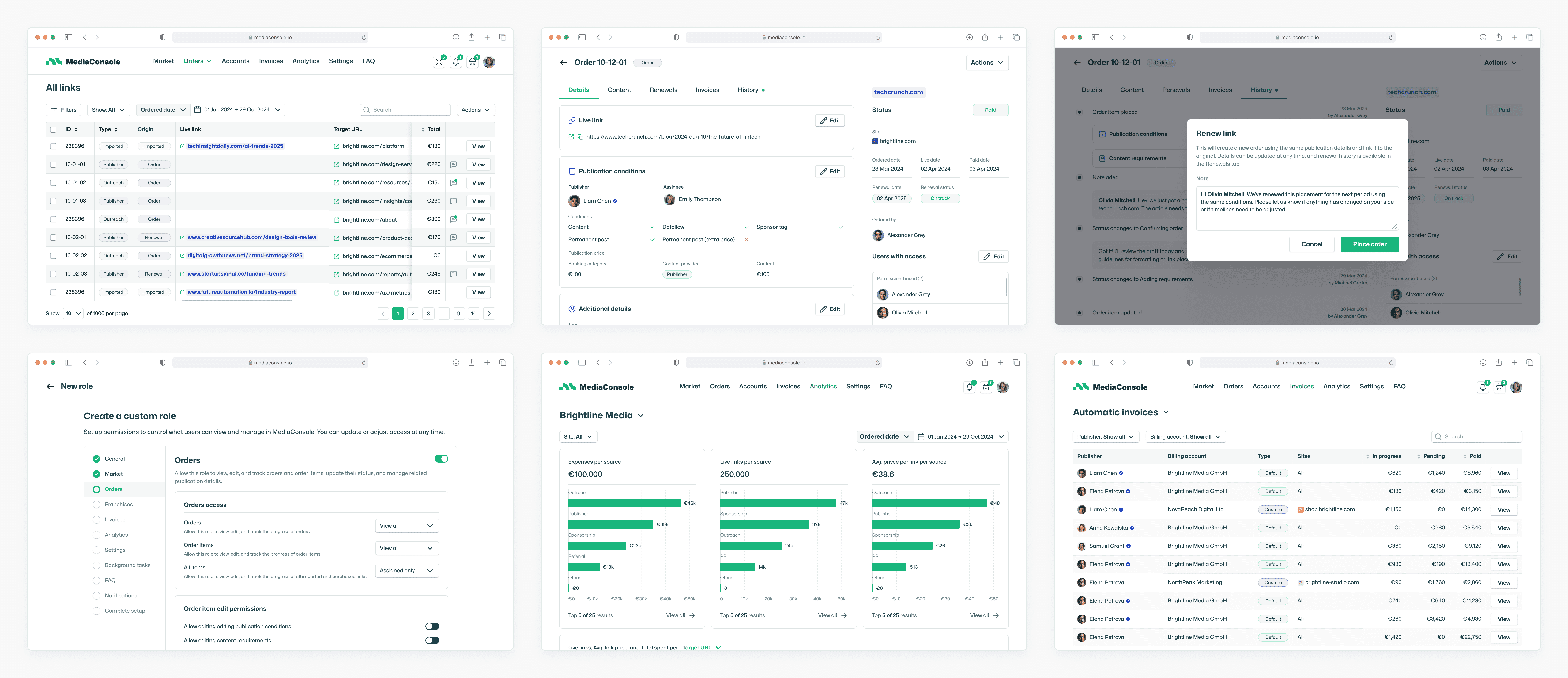
As the client teams adopted the platform, new needs emerged. Teams needed to collaborate across departments, manage renewals, track backlink quality, automate financial processes, and gain visibility into team performance. Instead of building standalone tools, we extended the Order workflow to support every stage of the SEO lifecycle.
New capabilities:
Team collaboration
Campaign renewals
Backlink audits
Finance automation
Analytics dashboards
Role-based access
By building on the same foundation, each new capability integrated naturally into existing workflows rather than introducing additional systems or disconnected processes.
Outcomes:
Reduced repetitive manual work.
Centralized collaboration around every Order.
Expanded the platform beyond outreach into finance and publisher management.
Phase #4: Scaling campaign management
As agencies continued to scale, managing individual Orders was no longer enough. Teams needed better visibility across campaign planning, active placements, and historical backlinks while reducing repetitive coordination between teams.
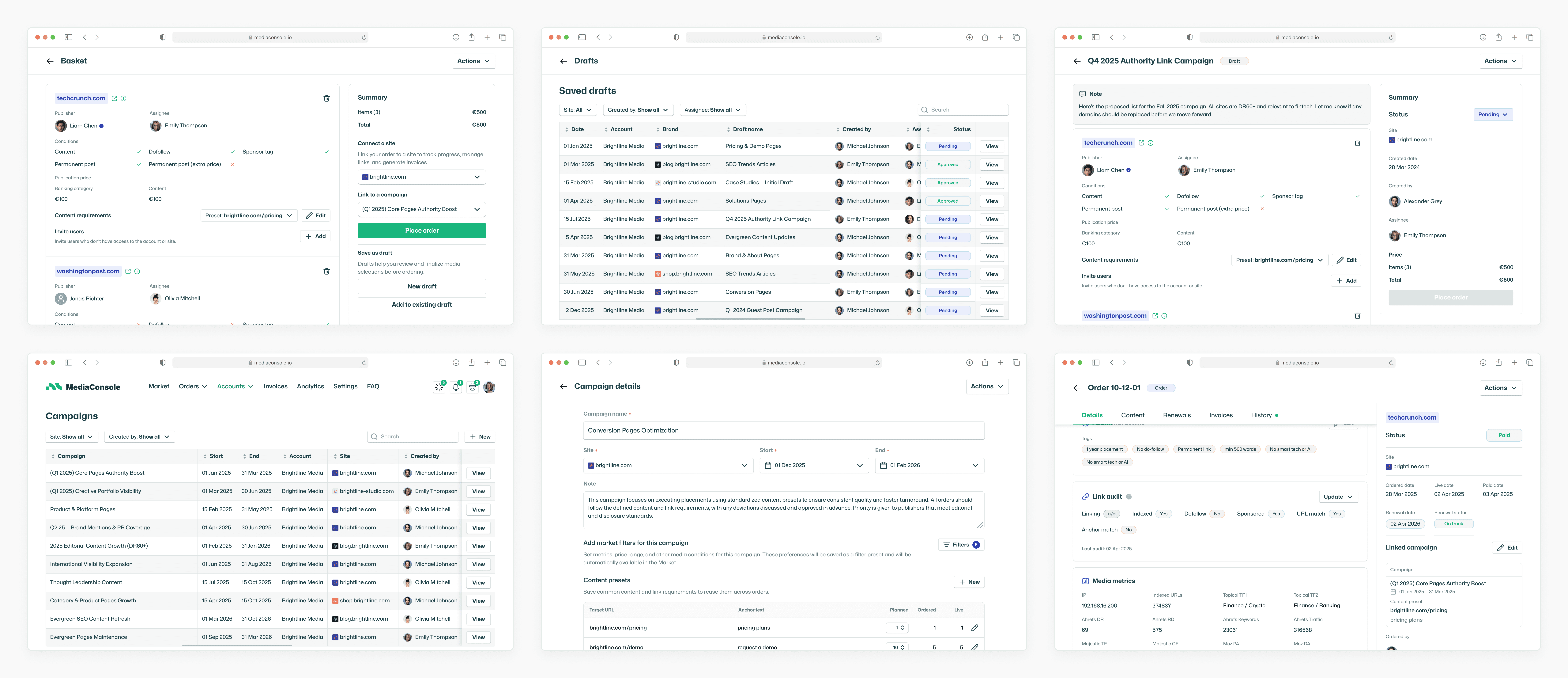
To support this shift, we introduced a new layer above the Order workflow that connected planning, execution, and ongoing campaign management.
New capabilities
Campaign management
Link management
Workflow automation
Role-based access
Campaigns allowed teams to define link requirements once and automatically populate publication details across related Orders, reducing manual data entry and improving consistency.
Drafts enabled teams to prepare websites before converting them into Orders, supporting more flexible planning and review.
The All Links view unified active Orders and existing backlinks into a single workspace, giving teams complete visibility across both current execution and historical results.
Outcomes
Unified campaign planning and execution.
Improved visibility across active and historical links.
Reduced manual work and operational errors through workflow automation.
Phase #5: Validating market demand
By this stage, MediaConsole had evolved into a functional product. The next uncertainty wasn’t whether the solution worked—it was whether the market was ready for it.
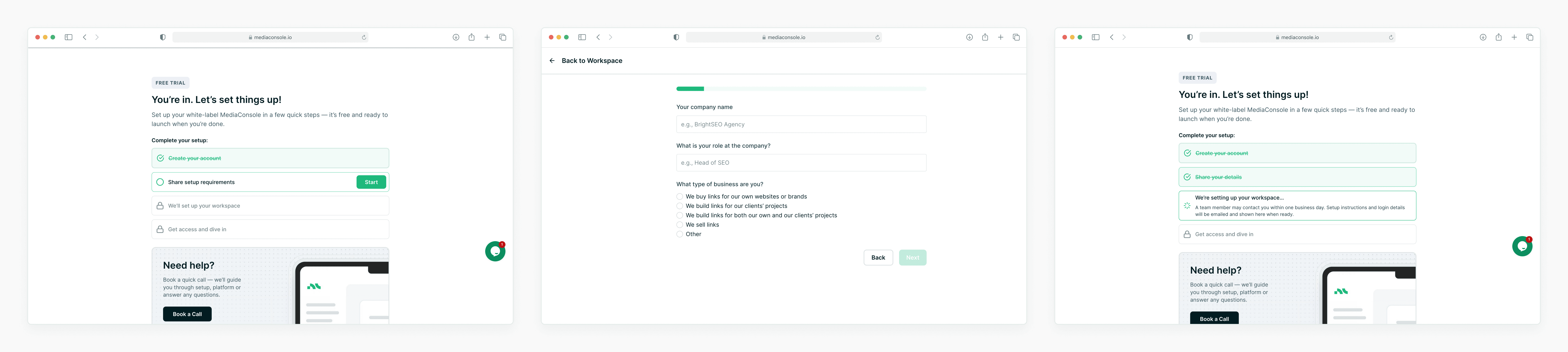
With the roadmap focused on core product capabilities, MediaConsole still lacked a self-service registration flow. Rather than diverting engineering resources, I designed and built a realistic onboarding experience in Bubble.io that allowed prospective customers to sign up, complete the onboarding process, and receive trial credentials.
This prototype created a low-cost way to validate demand and collect early customer interest before committing engineering effort to a production-ready onboarding experience.
Outcomes
Validated market demand without delaying the product roadmap.
Avoided engineering investment through rapid prototyping.
Enabled product-led demand validation with minimal engineering effort.
Impact and reflections
Key outcome
Reduced product uncertainty from idea to launch by leading product discovery, validation, strategy, and design in a Lean Startup environment.
Throughout the engagement, I transformed a vague business opportunity into a validated product concept by continuously reducing uncertainty—from customer research and workflow validation to scaling workflows and early product-market fit experiments.
Business status
By the end of my contract, MediaConsole had launched and entered sales. Product-market fit validation continued beyond my ownership.
Reflection
Scalable B2B SaaS products are built on shared operational patterns, not custom workflows.
Although customers believed their workflows were unique, research revealed a remarkably consistent way of working. Designing around shared workflow patterns enabled flexibility without sacrificing consistency, allowing the product to scale across different agencies without becoming a collection of custom solutions.
Looking back, I would validate product-market fit earlier, before investing in broader platform capabilities. Reducing market uncertainty is just as important as reducing product uncertainty, and solving the right problem ultimately matters more than expanding the solution.
Contacts
Let’s build something meaningful
Whether you want to discuss a role, collaborate on a project, or simply say hello. I’m always open to meaningful conversations.